
How do I love thee, Ann Patchett? Let me count the ways: effortless prose that communicates via gleaming, well-considered detail; showing versus telling in narrative; keen observations of character combined with a soft, painterly touch; rich-as-tapestry settings that almost become active characters in the plot; stories that strum the heart without throttling it or submitting it to misery. Whistler is, I believe, one of Patchett’s best works, and while it is very much at home in her archive (a sprawling but quiet family drama that unfolds over years of storytelling), it feels like a maturation, or a blooming, of her signature style.
At its heart, Whistler is about the stories we tell ourselves in the face of losing a loved one. It is about accepting death but choosing to close the door softly. It is about painting that tragedy with an impressionist brush: it is there, yes, but it is blurry about the edges–and why shouldn’t we make it so? We see this in the central story that Eddie tells his stepdaughter (the protagonist, Daphne) when they are pinned in a car on a cold night after a car accident: he talks about a horse (Whistler) that stays with a wounded woman who has fallen in a remote area and keeps her company until she is able to find help. He’s telling this story ostensibly to distract her from the calamity they are facing, but it is also a pointed tale of gritty survival. It is unclear whether Eddie manufactures this story on the spot or not; certainly, the fact that he later gives her a photograph of the horse suggests that he was passing along a story that had been communicated to him as a true account. (It also seems heavily detailed for an improvised tale.) But this central ambiguity makes the novel work. We are in a hall of mirrors with that story: who told it, and was it true? Are we willing to suspend belief and trust that the woman actually believed she saw her dog and horse while enduring grave injury alone for several days in the bare elements? Did Eddie make it up? Did Daphne misremember details? The more I pressed on these points, the more I realized Patchett’s point: the veracity of the ur text doesn’t matter. The point is that we are telling stories to comfort one another. (As Patchett writes: “How do we talk about death but to lie about it?”) We are choosing to surround ourselves with the warm blanket of a love story, of a reunion, of a triumphant return. These are choices in life. These are reasons to read.
Patchett underlines this ethos by choosing not to show us Eddie’s death. She arrests that part of the narrative by writing: “Eddie rested his head against my shoulder. ‘I didn’t realize I was so tried. I need to close my eyes for a minute.’ This minute. He was right. Stop everything here. ‘What about the book?’ I asked. ‘You’re the smart one,’ he said, yawning. ‘You’ll figure it out.'” And Patchett does, in a clever meta-fictional move, by ending the entire novel with one final flashback demonstrating the love between this father figure and daughter figure. One final, soft note, played fermata.
Landon is nearly done with the book, and has been enjoying it. He commented one night: “I love this book, but I’m nearly done, and what has even happened? A stepfather and stepdaughter hang out a few parties.” We laughed about that, because it’s true: this is not a densely plotted story. Much of it unfolds over conversation in backyards and at brunch tables. A lot of it is flashback. It is a quiet book. But I think this is a deeply intentional locus of authorial intent. As with her earlier books (The Dutch House, Commonwealth, Tom Lake), Patchett makes a home for herself in the deeply unfashionable middle of things: the long marriage, the later-in-life reunions, the complex and evolving dynamics between siblings. These are not the flash-in-the-pan, saucy romances of a 20-something-year-old; they are not gutting dramas or back-stabbing intrigues; these are no monomyths. Patchett is instead interested in approximating the real drama of a normal life: where we truly feel our hearts beat and bend and bleed. And she does it while modeling incredible grace toward the complexities of our inner worlds.
Some of this book could border on the saccharine were it not for the quick-draw, nearly-wry intelligence that courses through Patchett’s writing. For example, when recounting the story of how close Daphne’s mother came to letting her older daughter, Leda, go to sleep (and possibly die!) with a ruptured appendix, Patchett writes: “”Your poor mother,” Abigail said, knowing how close she’d come to letting Leda sleep. All of life’s mistakes were the fault of the mother, all of the suffering.” The tone walks a perfect line between droll and earnest, but there is a distinctively sharp, keening sarcasm in there, too. Patchett nails something similar when Abigail later says: “It’s an awful business, loving another person.” Then there is the arch banter between Eddie (who comes out as gay) and his ex-wife, Abigail: “‘The girls exaggerate everything,’ [Abigail] said. ‘The boys don’t do that. Turns out what they say about boys is true, they’re easier.’ ‘I’ve found that to be the case,’ Eddie said, and our mother whooped out a laugh.” Later, Leda (who becomes a therapist) is talking about her childhood with Daphne, and says: “Compared to most people? Oh, honey, you have no idea what people do to their children. Our childhood was fine.”
And then there are those signature Patchett lines that just feel good to read, the prose equivalent of the first sip of an ice cold martini or a perfectly dressed bite of salad, with all the best ingredients stacked on one tine. Things like: “Oh, this moment, when all the leaves were fresh and the lilacs were out and New York seemed like the best idea.”
A joy! As is, of course, the setting, especially for anyone who has lived in New York — she captures the feeling of the city so well and with seemingly so little effort. What a delight to have central scenes unfold at The Met, to understand how it feels to meander through Central Park while processing complex news or stroll uptown after too much champagne somewhere along Central Park South. These atmospheric details are, simply, perfect. The scene at the Plaza was a complete cinematic joy to take in.
All in, a five star experience for a five star book.
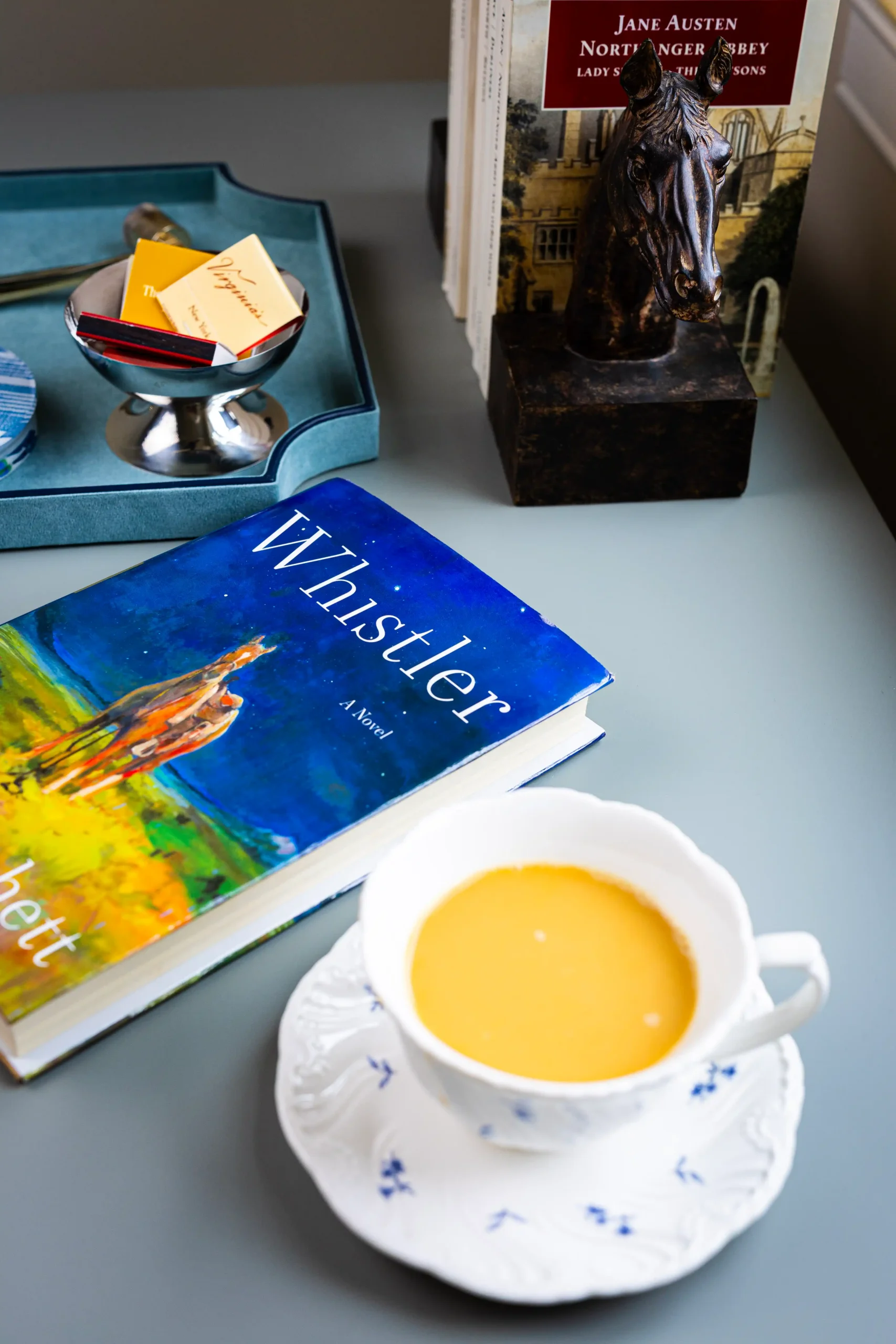
Whistler by Ann Patchett Mood Board.
I aways have such joy recreating the universe I’ve been imagining in Pinterest! The full pin board for this book here.
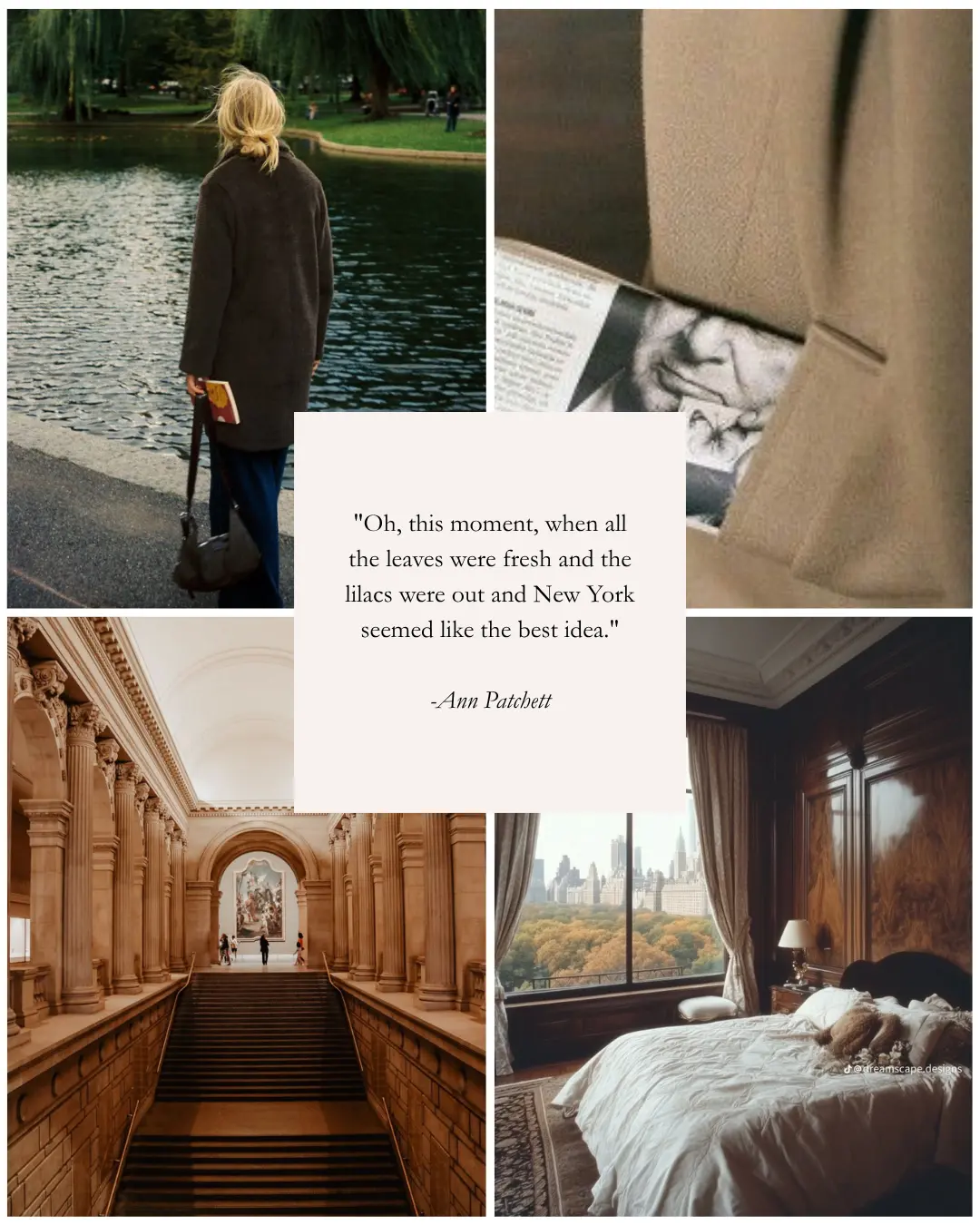
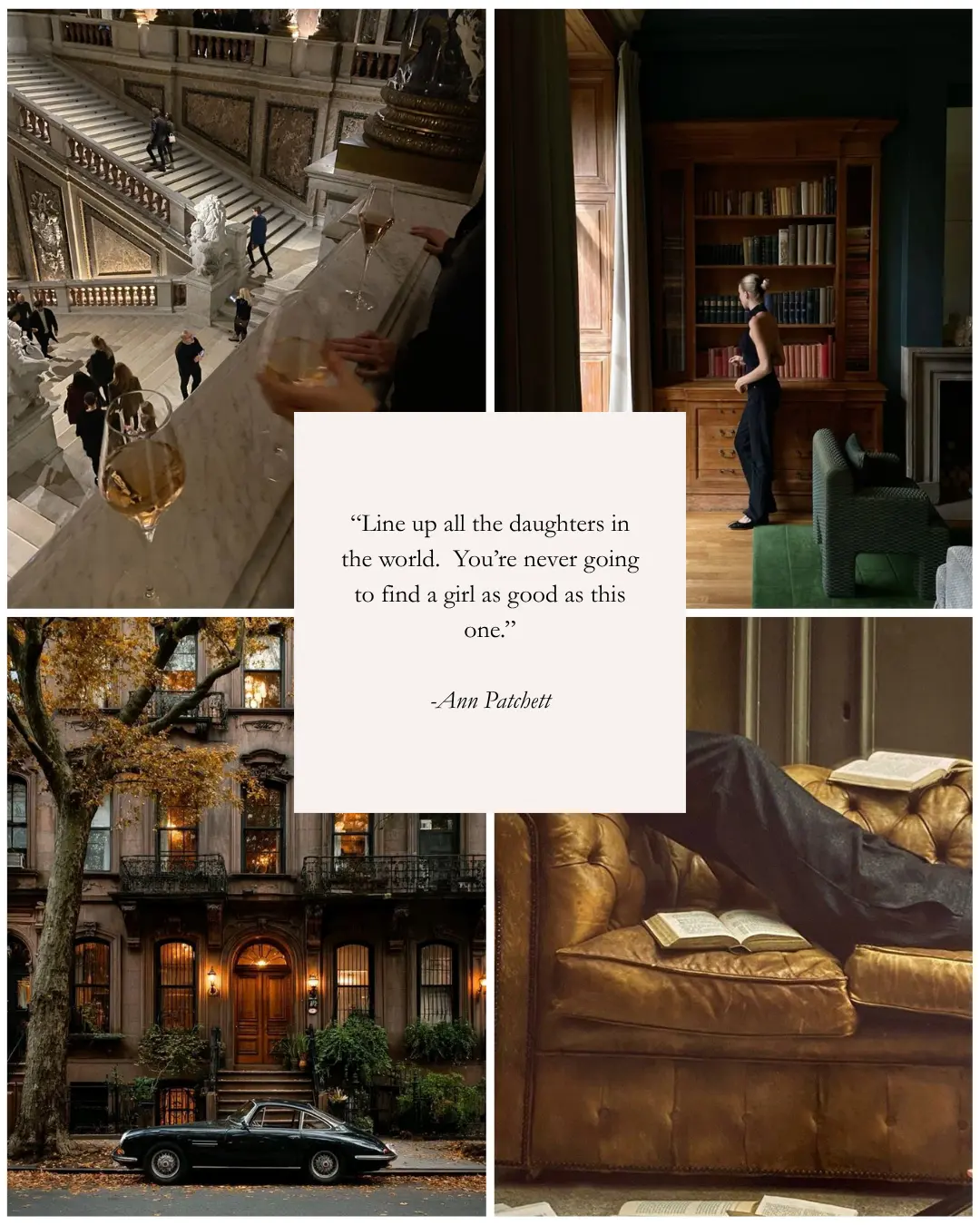
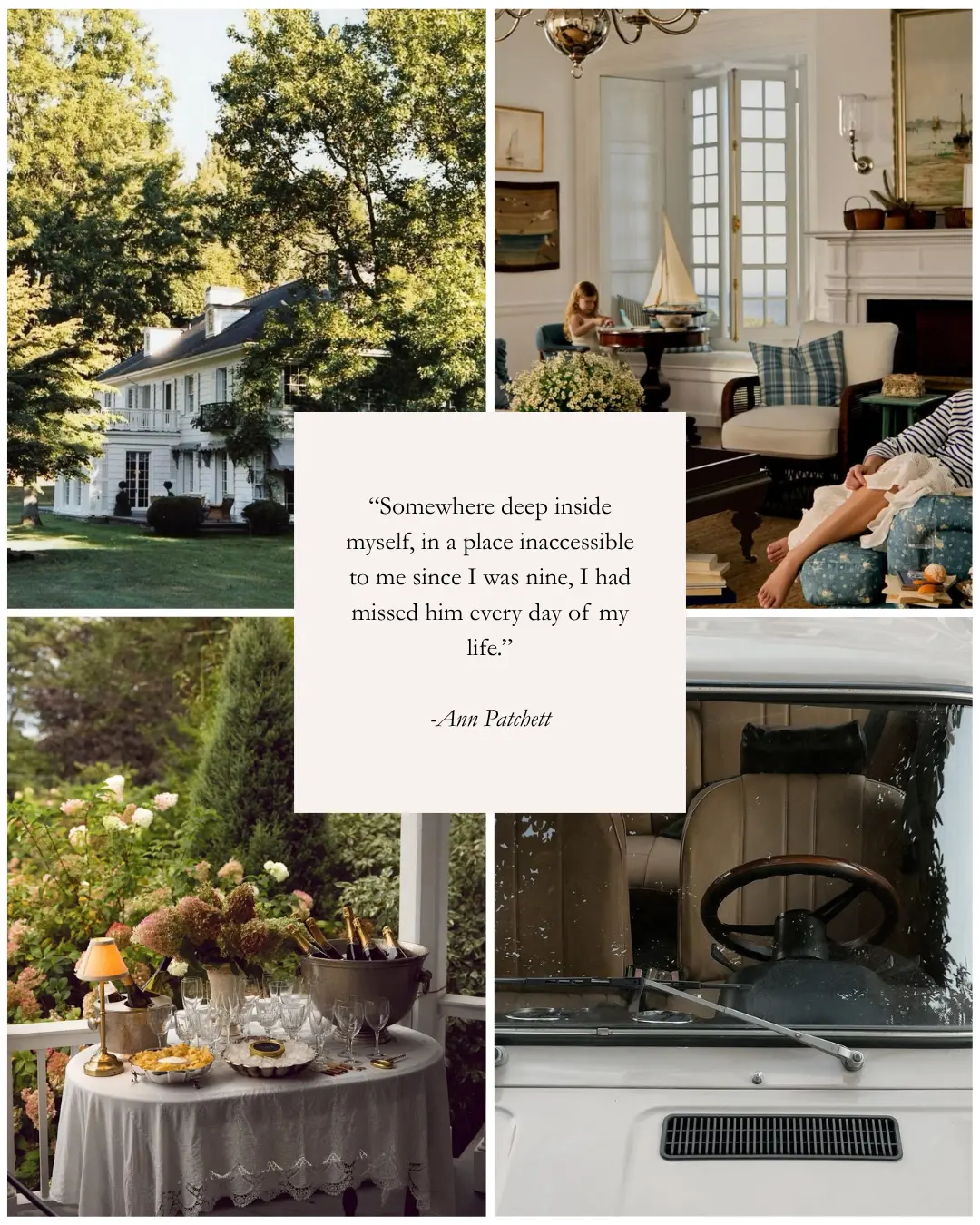
Whistler Book Club Questions.
+Why is the book titled Whistler?
+What did you make of the flashback at the end of the story? Why did Patchett close on that moment?
+Examine Leda and Daphne’s relationship with their mother. How did it evolve (or not) over time? Meanwhile, how did their relationship with Eddie evolve (or not) over time? What does the book suggest about parenthood and child-parent dynamics?
+The book talks a lot about writing and editing; both Daphne and Eddie’s careers are dedicated to it in different ways. Why do you think this is?
+Let’s talk about the settings. What stood out to you? Why did Patchett position the narrative where she did? How did it compare to the settings in, say, Dutch House and Tom Lake?
+Discuss the relationship between Daphne and Jonathan. What did you make of it?
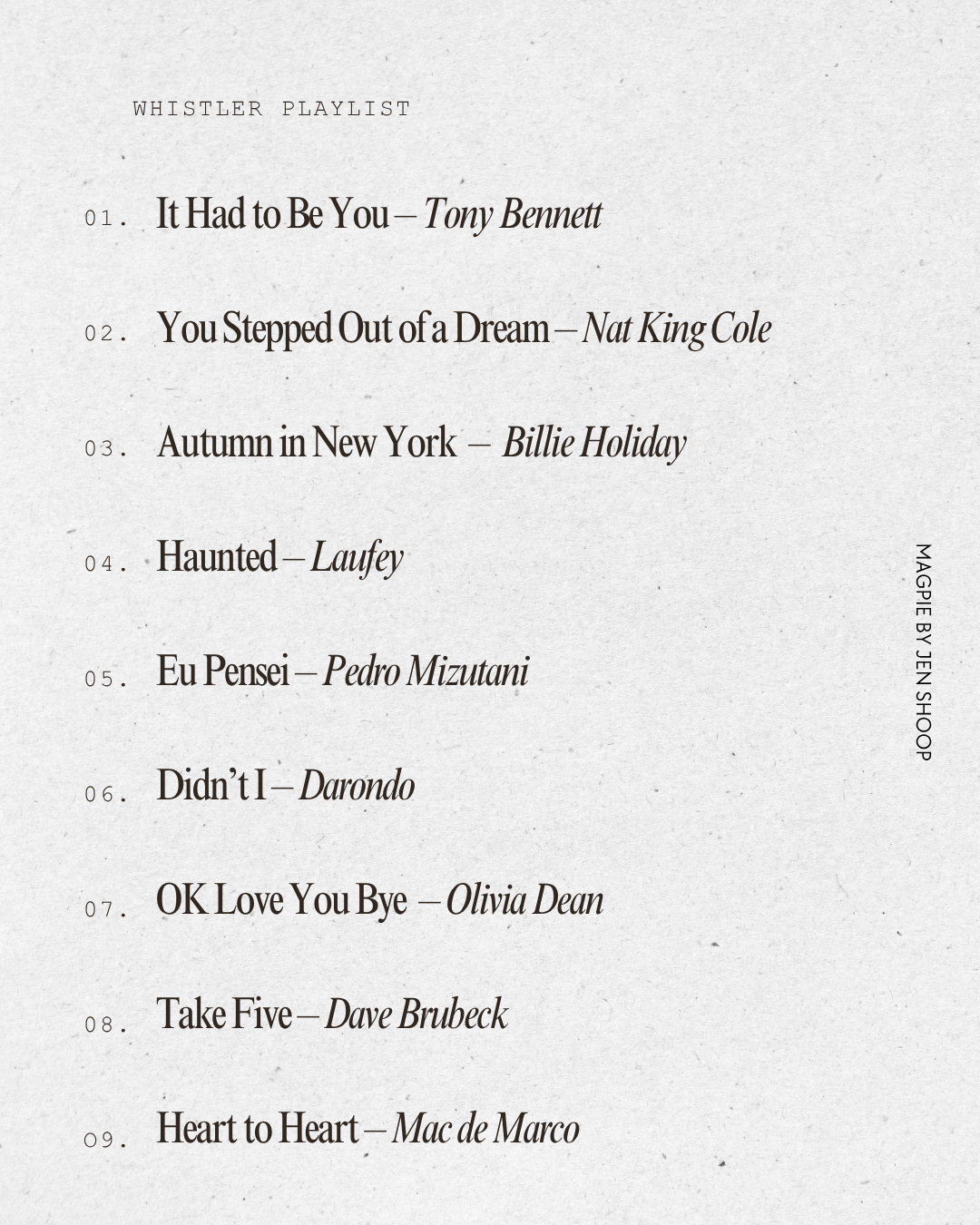
Whistler Playlist.
Sort of a Nancy Meyers nod here — jazzy tinkling cocktail hour — but with a couple of fresh tracks from Mac deMarco and Olivia Rodrigo mixed in for good balance. Had to include “On the Street Where You Live,” of course: Eddie and Daphne dance to it!
You can find the playlist on Spotify here and Apple here!
Dream-Casting Whistler.
One of my favorite activities this summer: dream-casting this book with our best friends. A couple of casting ideas we debated over dinner one summer evening:
+Daphne: Anne Hathaway (younger), Julianne Moore, Laura Linney, Holly Hunter (I kept thinking of her eyes during those scenes where Daphne is with Eddie getting his cancer treatments), Cherry Jones (older — mainly because she reminds me of Ann Patchett herself)
+Leda: Gwyneth Paltrow or Rose Byrne
+Abigail: Blythe Danner
+Eddie: Nathan Lane, Stanley Tucci, Paul Giamatti
+Jonathan: Matthew Broderick, Alan Ruck, or Andy Buckley
+Hotallers: I loved these characters (wow — Daisy and Tom Buchanan vibes), but couldn’t think of the perfect actors. The wife would need to be petite, brittle, uptight. The husband would have to be a dapper but cutting golden boy.
Whistler Bloody Mary.
For some reason, I read this and immediately craved suburban brunch foods — ha! I was dayadreaming about this French Toast Casserole, a spicy bloody mary, and some good bacon. I’m adapting Death & Co’s Blood Mary Recipe below.
Ingredients:
2 oz gin (you can use vodka but I’m a gin girl)
5 oz Basic Bloody Mary Mix (see below)
Garnish: 1 lemon wedge, 1 olive, 1 cube of cheese on a toothpick
Fill a tall glass with ice cubes. Mix 2 oz gin with 5 oz mix and pour into the glass. Garnish with items on a toothpick.
Death & Co House Bloody Mary Mix
1,100 grams organic tomato juice (bottled)
180 grams Worcestershire sauce
30 grams Maggi seasoning
72 grams strained fresh lemon juice
72 grams strained fresh lime juice
30 grams hot sauce
Place all the ingredients in a bowl and stir to combine. Transfer to a storage container and refrigerate until ready to use, up to 1 week.
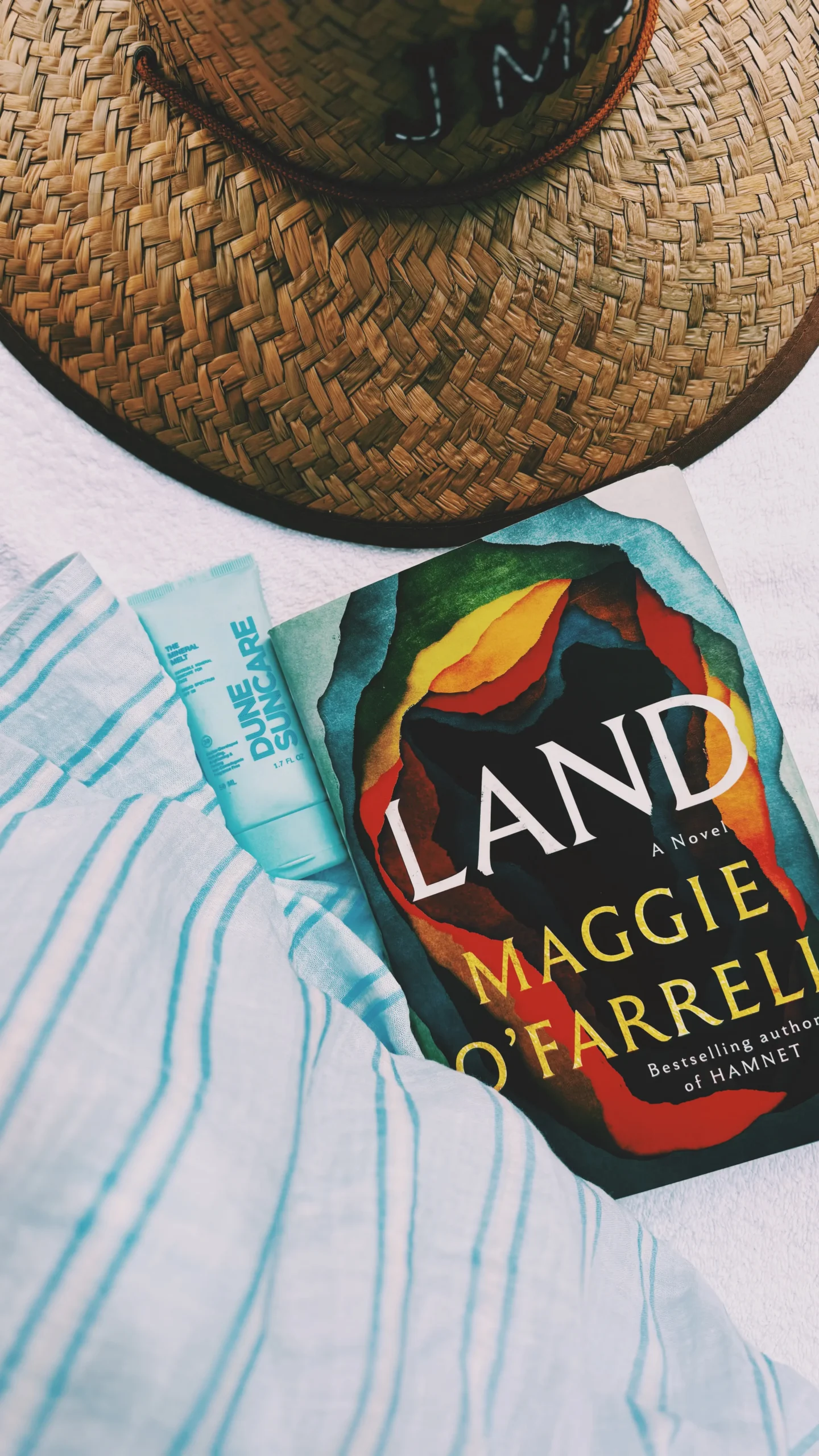
Next Month’s Book Club Pick: Land by Maggie O’Farrell.
Next month, we’re diving into Land by Maggie O’Farrell! Set in the time of the Great Hunger in Ireland, it has been described as “A breathtaking hymn to the sanctity of natural spaces, operating on timescales both intimate and geological.”
P.S. Beach read recs here!
P.P.S. More book reviews and book-ish conversations here.
P.P.P.S. My most visited book review I’ve ever written.
This content may contain affiliate links. If you make a purchase through the links above, I may receive compensation.

Wait I thought Whistler left then came back when she whistled! He was nearby but not there until she realized how badly she needed to move forward through pain and not dwell in the past even though it felt easier. That feels like a very important distinction to me! Also loved the line about helicopter parents mistaking co-dependency for love… a lot of this book made me think of the space love can hold.
You’re absolutely right, Carey – I miscast/miswrote that synopsis! Thanks for the catch; I agree that’s an important distinction.
I agree on the line about co-dependency — I read it out loud to Landon after I came across it! Made a big impression on me.
xx
I felt giddy reading your words. A fellow reader who loves reading really good books. I loved having a main character close to my own age! Also, I’ve gotten so used to expecting “something” to happen when I am reading a novel, It was nice to just read and enjoy. I savored rather than reading (listening) as quickly as I could. Ann’s voice made it even more enjoyable.
I agree — “savoring” is the right word. Just so luscious and delightful. Thanks for the kind words about my review, too, Michele 🙂
xx
“It is about accepting death but choosing to close the door softly. It is about painting that tragedy with an impressionist brush”
While you have written so many excellent sentences, these two are exceptional. Just brilliant! Thank you.
Oh thank you so much, Kiki! I appreciate this note more than you know.
xx
This post was perfectly timed for me, just finished the audio book this morning on my drive to work. Lots to say, but I’ll focus on one thing that’s top of mind: I found Daphne’s perspective/relationship to her mother to be surprisingly ungenerous to the point of making me feel less sympathetic towards Daphne in general and less trusting of her as a narrator over all. Her mom seemed to have done her best raising two children alone and juggling a career and some difficult men. Yet, Daphne seems to see her mother as this selfish, self-absorbed creature, and I just didn’t see the evidence of that. The fact that the narrator describes her childhood as so terrible that it kept her from becoming a mother because she didn’t want to give anyone else a childhood seemed incomprehensible to me. I acknowledge I’m approaching this as a mother of little ones myself and therefore instinctively defensive towards villainizing mothers. I think the book did a good job of presenting Abigail as a three dimensional character and not a villain, but the fact that Daphne, who seemed to otherwise be a reflective, discerning person, seemed so unaware of that, even when her sister overtly points it out, was strange to me.
I can see this! I think Daphne is clearly in the midst of unpacking things / understanding her childhood / sorting through it all, and Eddie is a foil (or maybe instigator) for that, but I’m not sure we see a ton of progress on her perspective on her mother…I also think mother-daughter relationships are complex, and her mother seems uninterested or unwilling to listen to Daphne’s side of what was clearly a traumatic life event until the very end of this book, which probably made a deeper relationships impossible.
Still, I understand how this strums at some very tender feelings for us moms. I really do understand that. I also found Daphne’s relationship with her husband at times uncomfortable to me — like I cringed when she omitted the fact that she was seeing Eddie from her conversation with him at the beginning. It felt like such a betrayal / lie to me!
xx
Yes, that omission made me uncomfortable, too. But I think the through line here is Daphne omitting information, whether it’s not telling her mother the full story about what happened in the car accident or not telling Jonathan that she was seeing Eddie, to spare the other person potential discomfort and spare herself a moment of potential friction or confrontation. But by doing that, she is playing into the feeling of not being seen or known by not allowing others to know her, which is sacrificing true intimacy. And I don’t think she ever acknowledges her role in building this world of loneliness for herself.
I agree with this read! I do think the theme of not being seen/known runs throughout the telling of her character.
xx
I thought this was a beautiful book, and I shed more tears reading it than I care to admit. Yes, about death and love, but also about being seen. Five stars for me!
Being seen — yes! It felt like Daphne was searching for Eddie’s eyes, his knowing, his compassion her entire adult life!
xx