
“We long for what can be fulfilled in time,
Though death is in the cost. There is craving
As in delayed completion of a rhyme.” — Wendell Berry
Beloved American poet Wendell Berry passed away this week. His craft not only shaped the naturalist bent in my recent-year writing, but kept me company during several specific and acute moments of loss, confusion, and helplessness. His best-known poem, “The Peace of Wild Things,” captures so well the comforting surrender of spending time outside, far from the language of the day:
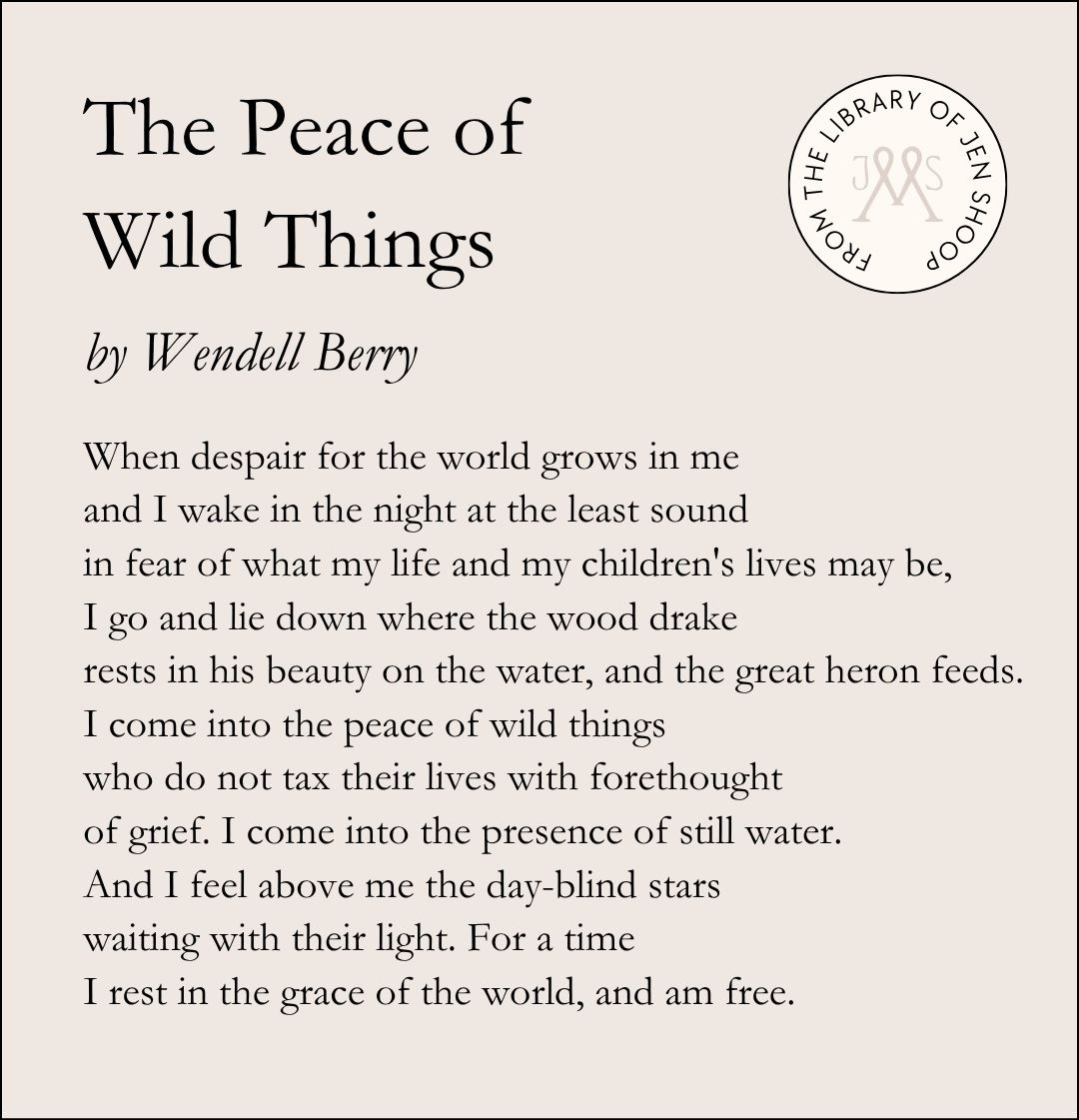
The phrase “forethought / of grief” has been — perhaps strangely — a particular reassurance to me over the years. It gave a name to the subterranean feeling of sadness I carried before Tilly passed, and while contemplating the aging of loved ones. The confident arc of this expression made me realize how human it is to anticipate death. I had wondered if I was abnormally preoccupied with it because of the loss of my friend Elizabeth at 25. I would think — even before Tilly was diagnosed — about her one-day passing, and then upbraid myself: tsssk, how morbid! The very presence of Berry’s phrase made me see how natural, how universal, it is to worry over the endings, and how the outdoors can be a salve for those pre-bruising thoughts. After all, in nature, as he beautifully reveals, there is only the deeply present, the immediate, the still water, the day-blind stars. There is no tomorrow; there is now.
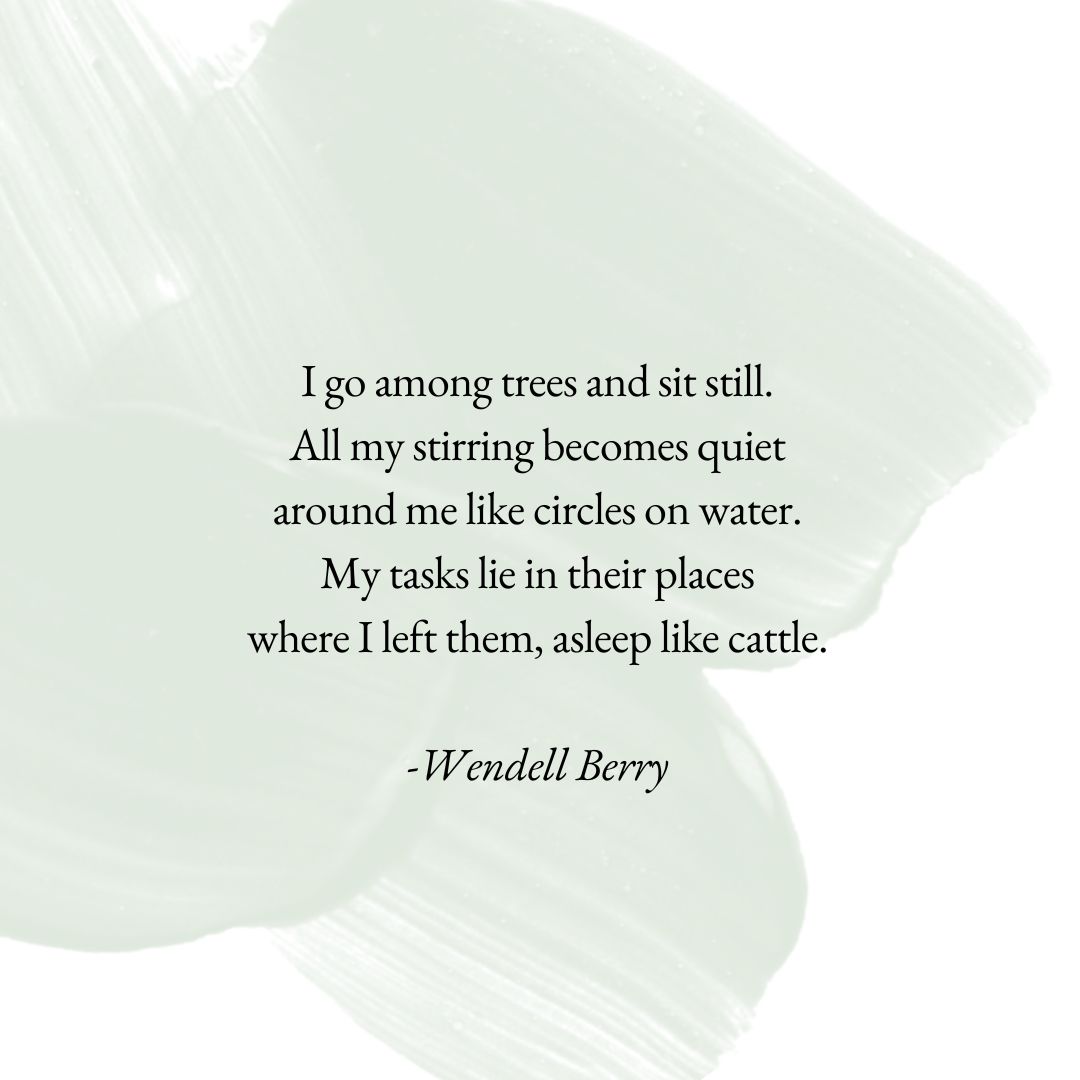
Last year, I purchased a couple of poetry volumes featuring what he termed his “Sabbath Poems,” or poems written out in the woods during his Sunday morning walks. Many of these are brief observations, in accessible language. Some are so straight-forward as to read like prose, and the unsuspecting or impatient reader (which I am occasionally known to be) is wont to skip from page to page if not careful — but there are gems hidden in the lining. In the preface to one of the collections, he explained that the poems were “written in silence, in solitude, mainly out doors,” and that the reader “will like them best […when read] in similar circumstances — at least in a quiet room…with more patience than effort.”
“More patience than effort”: a perfect poetics. Or a poetics defined by the soft, waiting kind of love, the unforced and open-hearted sort.
A day or two after Berry’s passing, Landon and I drove home (from a funeral no less) and found a red-shouldered hawk perched in one of the low plum trees by our garage. We never see hawks so low to the ground; we stopped the car to observe it and discovered it was eating a baby bunny. The next morning, we found a dead raccoon (!) in the garbage bin by our side door. I texted my sister-in-law these macabre happenings; she is a keen observer of the natural world and will often send me photographs of birds, mushrooms, flowers she’s happened upon. We’d never even talked about Wendell Berry before, but she wrote:
“Maybe it was Wendell Berry’s spirit-influence since he died the other day?”
I don’t know, but let me put it this way: his loss is felt acutely here, in this backyard in Bethesda, and around the world. He was one of those rare poets who was able to soothe us in moments of terror and confusion, and to do it from a place of solidarity versus didacticism. It was never “buck up” or toxic positivity or sagacity delivered from remove; it was “here, life can be hard, let me pull up a chair,” and — in the words of Mary Oliver — “tell me about your despair and I’ll tell you mine.”
In memoriam. Rest easy, Wendell Berry, 1934-2026.
P.S. I included “The Peace of Wild Things” in this roundup of poems that feel like a deep breath.
P.P.S. On being un-precious with books.
P.P.P.S. I also published a Sunday shopping post with my latest Labor Day sale finds here.

This is beautiful, Jen! I recently read this Substack article: https://writingteacher.substack.com/p/what-wendell-berry-taught-me-about?utm_source=substackpost&utm_medium=email (if the link doesn’t work, please search “What Wendell Berry Taught Me About Being a Teacher” by Liz Prather, the Substack is Your High School Creative Writing Teacher.
I loved this line: “A teacher’s job, he told us, was to arm children with tools against loneliness.” This really resonated with me as a teacher and I’ve been reflecting on it in my work as well as parenting — how to ensure that all children (and my young adult students) feel that they belong, contribute to, and thrive in a space or community.
“More patience than effort” — oof this phrase is calling to me as well. How much energy/effort do I expend during the morning rush of my daughter getting ready for school, and how much of this can be replaced with patience?
Gosh, that quote about arming children with tools against loneliness. So moving. What a beautiful mantra / north star / goal.
And I’m with you on the patience instead of effort through-line as it applies to parenting. Super hard! I was just thinking about how my son was trying to tie his shoe in the USPS (he was on the floor, blocking the path) and I was reallllly trying to just let him work through it but felt like I needed to chomp down HARD to prevent myself from expediting / jumping in / etc!
xx
Oh Jen, this was an absolutely stunning tribute. Your writing about the natural world is one of my very favorite things about your work – and there is so very, very, much to love. Like Berry and Oliver you have such a gift for noticing the small, beautiful things and giving them their proper weight. *Also a good reminder to me that I haven’t tucked into Mary Oliver’s documentary, a holiday weekend on the cusp of a new season seems the perfect time to do so.
Thank you so much, Hettie! What a loss. I also have not yet watched the Oliver documentary — like you, I’m waiting for a slightly quieter moment / quieter energy / quieter evening once kids are tucked back into school routines. It feels like a fall watch.
xx