
Wuthering Heights is my best friend’s favorite book; she’s read it (in her words) “1mx.” I’d read it once in high school but realized, on this re-reading, I had been merging parts of it with Jane Eyre, and the story took me by vigorous surprise. WH is unhinged! It is violent and dark (a dog is hanged in it?) and its characters behave in vengeful, petty, and unkind ways. I kept looking for a slip of porcelain and finding instead blade and corrugated edges. Bronte does not give us any soft landings. She writes bravely, unflinchingly to the wick of things. I am imagining her temptation to warm the characters, to sand down the rough edges, to stamp out the vantablack, but she gives us instead a determinedly bleak story about an orphaned boy subjected to abuse and social ostracization who falls in love with a woman he is forbidden to marry, and who spends the rest of his life in self-immolating agony and vitriol.
But was it love, after all, I wonder? Is Heathcliff destroyed by a broken heart or consumed by bitterness toward his circumstances? Certainly he seems obsessed with Catherine (and her ghost) for his adult years, but most of his actions in his later life seem motivated by revenge towards Earnshaw, perpetrator of deep unkindnesses toward Heathcliff as a child. Meanwhile, Catherine is highly self-involved and her feelings for Heathcliff often seem either underdeveloped (a childlike, convenient attachment), possessive, or self-serving, i.e., she was drawn to Heathcliff because she met her match in him, not because she had any real empathy or softness toward him. It is a claggy business all around.
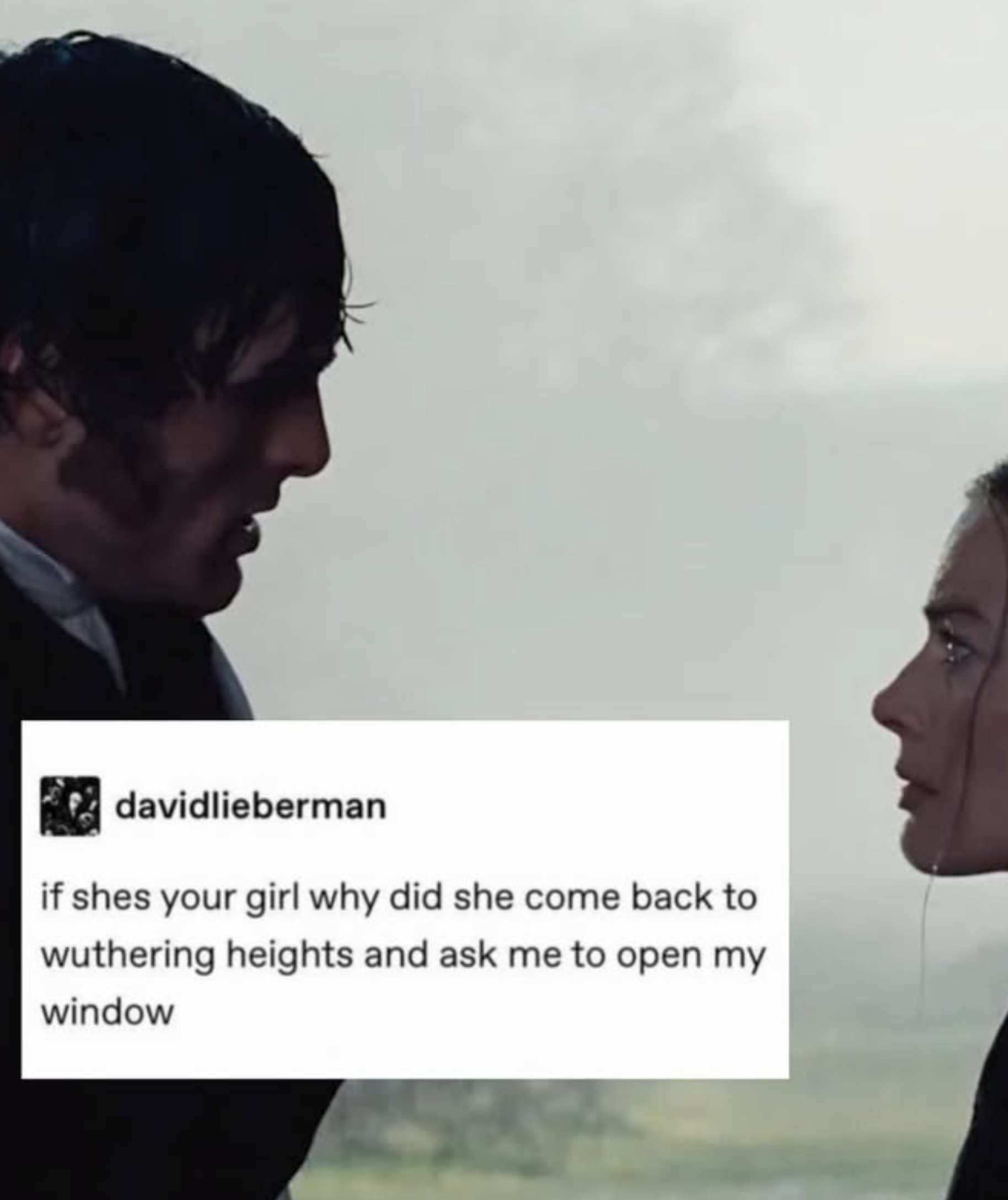
This meme just about captures it:
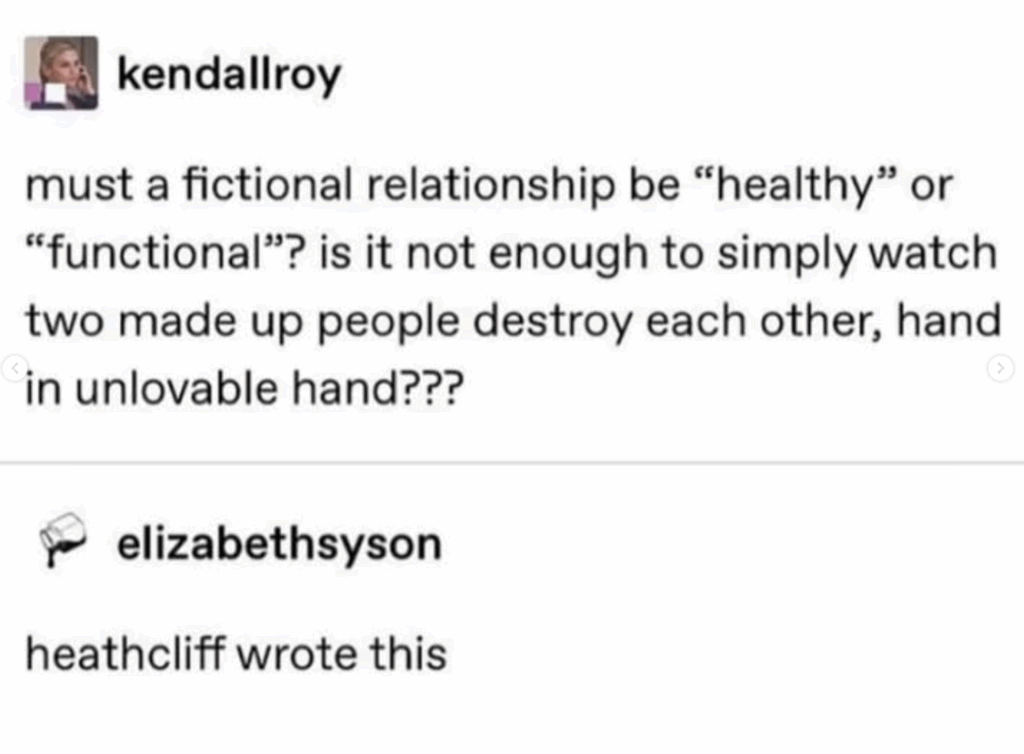
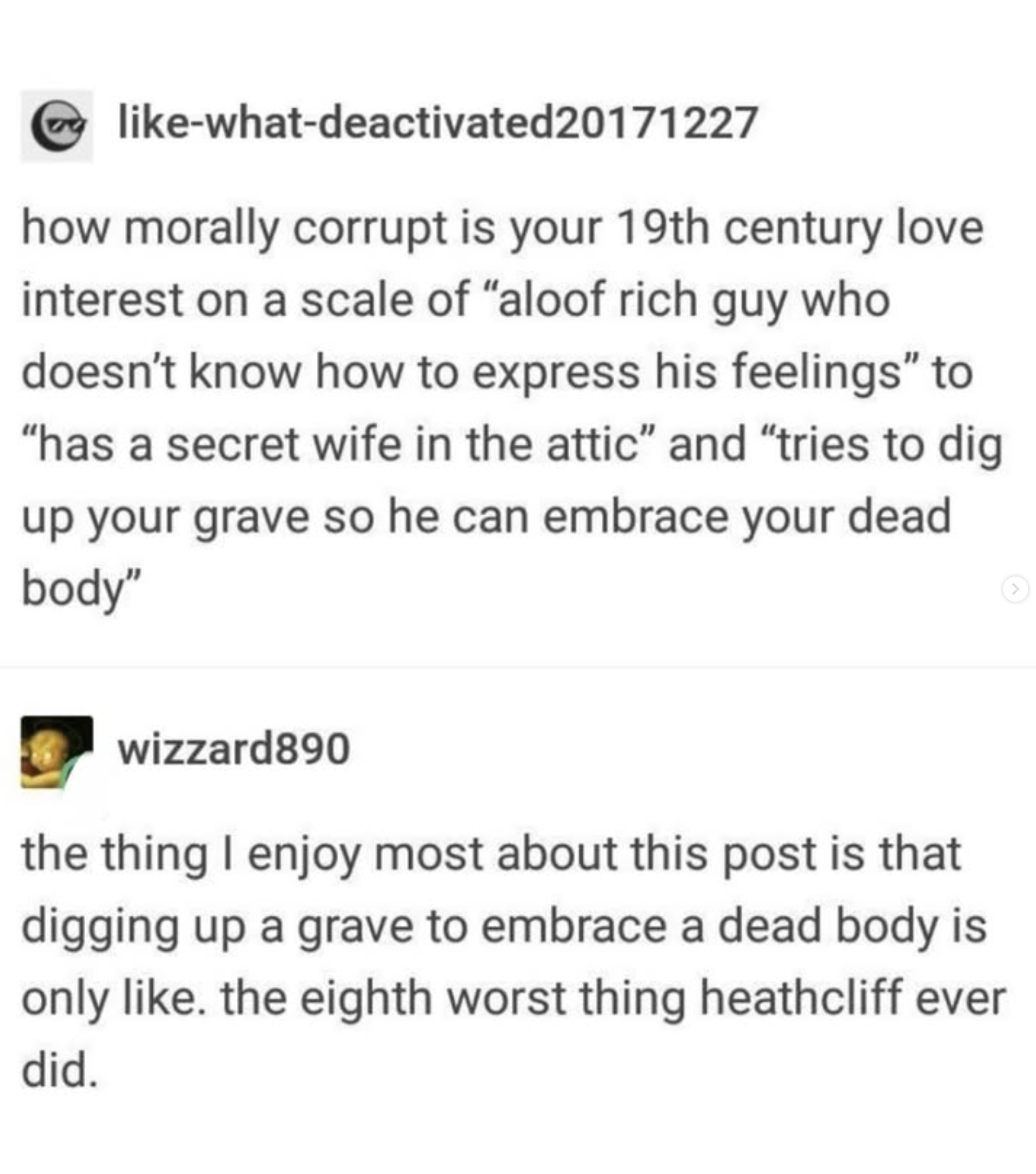
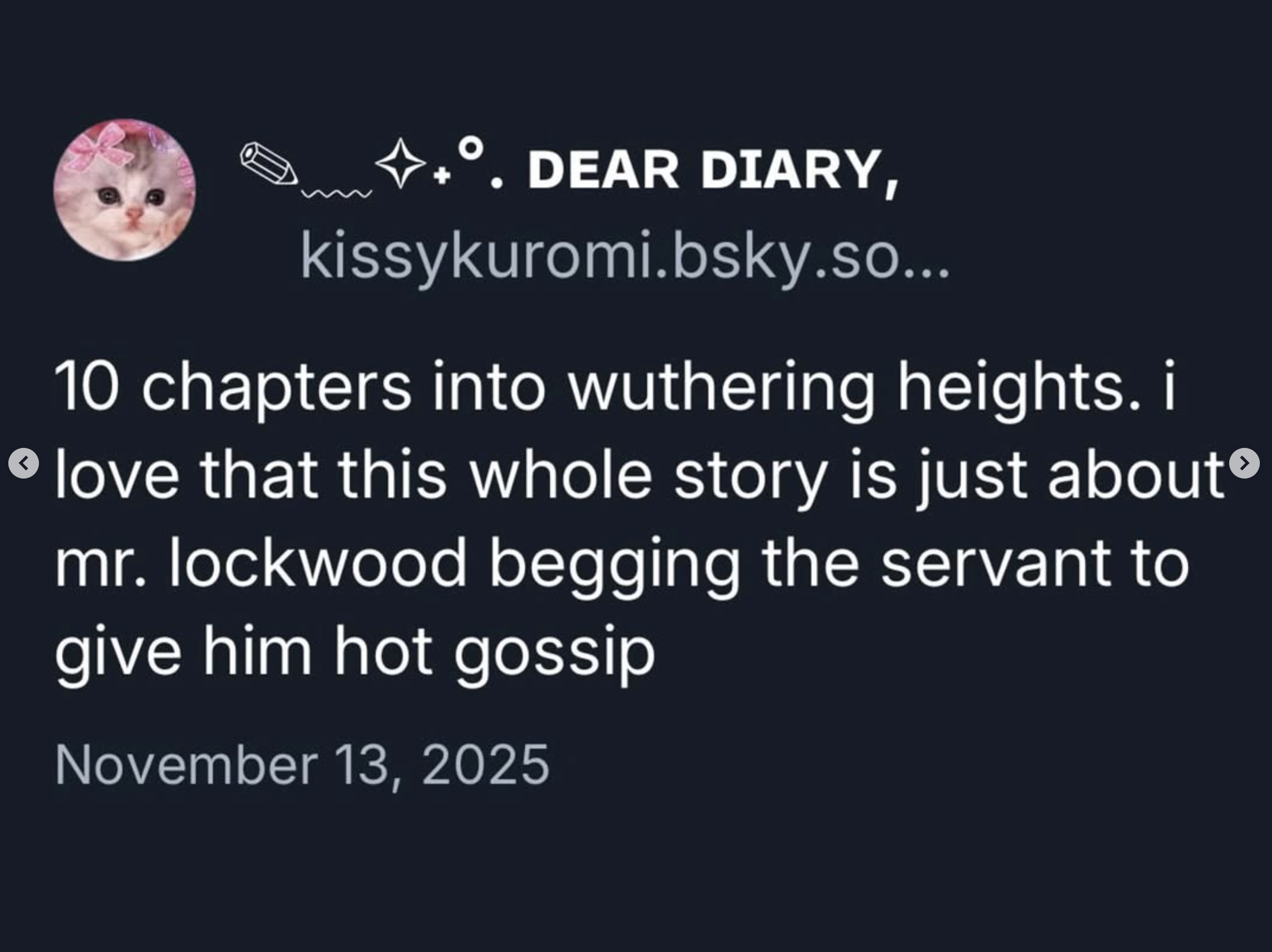
Heathcliff is beautifully complex. He is a true Byronic hero: a brooding, discontented outcast who, in spite of his dark moods and haunted past, possesses an undeniable charisma. (This tracks, by the way, with Bronte’s reading history: she immersed herself in second-wave Romanticism via her father’s collection of Shelley, Scott, and Byron and participates in that literary tradition. Interestingly, when she published WH, contemporary critics considered her work odd and out of keeping with the times — released in 1847, the novel is set in 1801 and flirts with early-stage Gothic conventions that might have felt old-fashioned or “retro.” Have you ever read the Castle of Otranto? It’s considered the “ur text” of the Gothic movement, and was published almost a century before WH. Otranto centers upon a decaying castle and a thwarted family legacy/lineage — certainly themes Bronte was manipulating. I love this tidbit of Bronte context: her juicy a rebours flair.) I kept waiting for glimmers of inner warmth to thaw my view of Heathcliff, and occasionally it is as though we see the weather change behind the window, but we never find any resolution for him. There is no turning point, no recovery, no change of heart, no redemption. This is not a moral story; is there any character development at all? Heathcliff remains staunchly himself, a stony facade around a decaying interior — much like Wuthering Heights itself. Was Bronte cautioning against the depth and irreparability of the psychological trauma that he had endured? After all, much of his callous mistreatment as a child centers upon his social status; Bronte seems to be flagging that class structure is a damning site of significant violence of various kinds. Interestingly, there are unkind folk of all walks of life in this novel, though, from Joseph the groundskeeper to Earnshaw the master; this is not a novel in which paradigms simplify into the “good” everyman versus an evil upper crust. The entire society of characters in WH seem rotted through. Even those who are less flagrantly unkind can be petty, haughty, churlish, and — mainly — self-involved! The level of self-absorption in this novel is astounding! (Lockwood, too!)
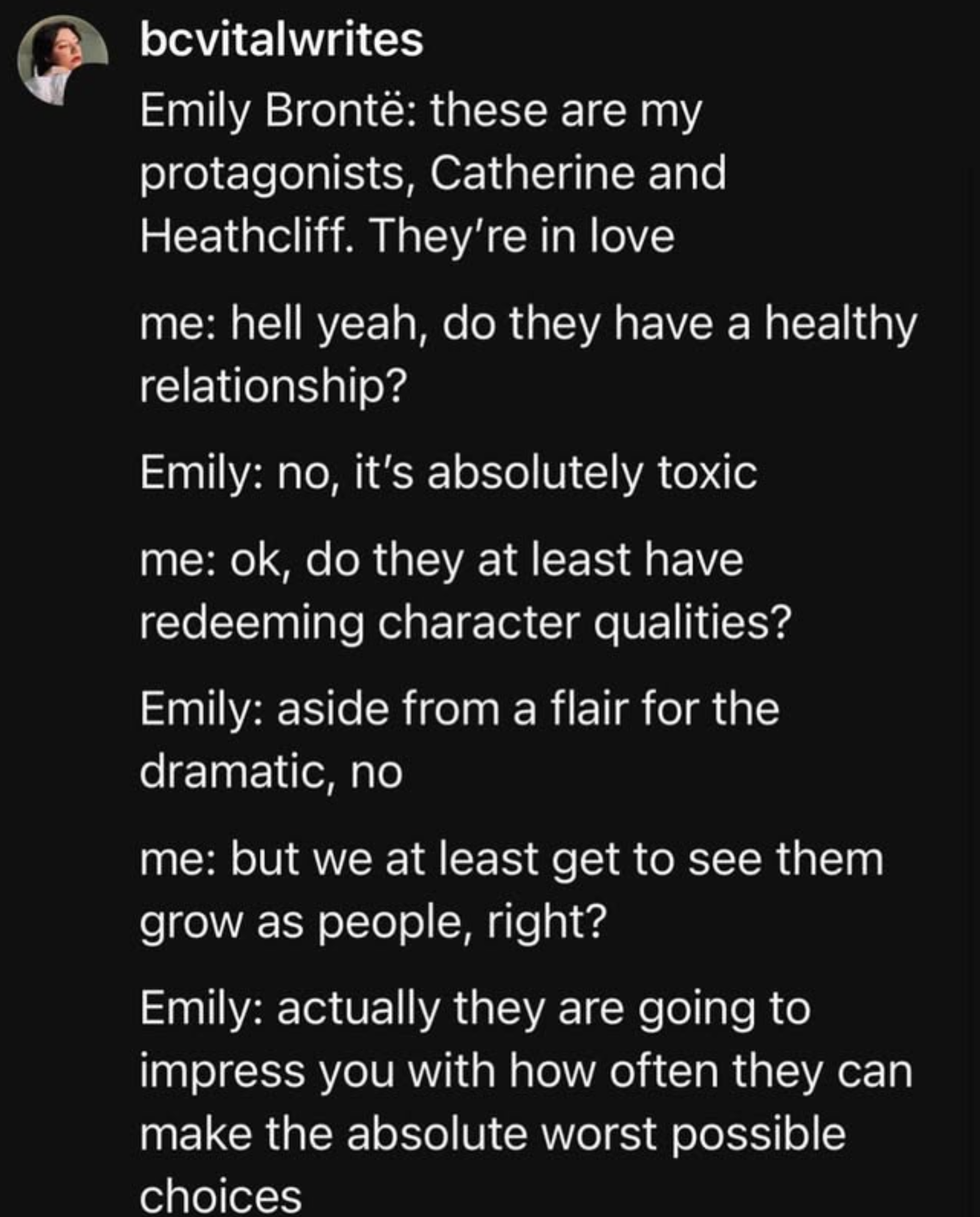
To wit — two fantastic memes:
WH has a dauntingly wide body of critical literature around it — and a cult following (and meme-density) to boot; rather than provide a typical review that might barely scratch the surface of what other more dedicated scholars and fans have contributed, I am instead below pawing at some of the themes, questions, and motifs that leapt out at me, and wondering what yours might be?
+Anxiety around familial relations and origins — A strong motif in the novel suggesting unease around social mobility and status. For example: Heathcliff as a fatherless orphan with ambiguous racial/cultural background; Lockwood’s initial befuddlement as to the relations between the “family” he encounters at WH in the novel’s open; the doubling of names across generations (two Catherines, two Heathcliffs — this made for occasionally difficult reading, which must have been intentional; I also noticed Bronte occasionally using ambiguous terms like “his ward” or “his companion” in ways that obfuscated the antecedent); the dissolution of families and family claims to property
+Layered narratives — WH is a patchwork of multiple fallible voices that work together to construct the story. We have the frame narrator of Lockwood, we have diaries and letters, we have Ellen’s recounting, and we often have Ellen reading letters within her recounting or quoting from characters who told her what happened when she was not present. Narrative instability x 10! Can we trust Ellen? Can we trust her memory? (Keep in mind, we are hearing Ellen’s recounting through Lockwood, who is deeply unwell and bed-ridden while listening — is he a reliable narrator to begin with?) We know she keeps close tabs and a good read on the moods and preferences of the people in the story; do we occasionally wonder if she is telling things in a certain way to appease or intrigue Lockwood? (There is a hint that he might be romantically interested in Catherine — is she trying to fan the flames?) She might also have her own agenda when it comes to class dynamics; she is an employee telling the landlord’s story to his wealthy tenant! Mainly, I wondered — what was the narrative purpose of Lockwood? What did he add to the story? Certainly another layer of destabilization — perhaps Bronte’s way of kicking up a little extra dust and gravel: there is never one clear story, one correct view.
+Insides and outsides of things — We have the two major edifices in the novel (WH and the Grange) and who belongs to each (largely defined by inheritance, although Heathcliff is able to trick his hated Earnshaw out of house and home); we have characters who are permitted inside certain rooms and not in others; we have arrangements and dissolutions of different friendships/relationships; we have Catherine and Linton in a marriage and the interloping Heathcliff, and then we have Heathcliff and Isabella in a marriage and the interloping Catherine; we have Lockwood as a visitor muddling his way into the family drama; we have the open window at the end, when Heathcliff has mysteriously died
+Connection between the physical and the intellectual — Bronte often describes a relationship between the mind and the body — i.e., brightness of eye suggests a keen intellect; I think more generally she was ahead of her time in seeing how physical wounds manifest on the inside.
+Construction of physical space in the novel — The visual of these two enormous houses separated by a fog-laden heath imprints itself on the mind in a fabulous, evocative way: much of the novel is, after all, about separation, isolation, “crossing between” (as in marriage), “crossing over” (as in transfer of property and death – there is a lot of death in this novel!). The use of physical space is a brilliant mirror for all of these negotiations. I loved the vignettes in which young Cathy is venturing further and further towards WH, towards learning about her family connections there, etc — and the “danger” of being apprehended by Heathcliff! I also thought WH’s gradual degradation and the Grange’s gradual closing up / de-tenanting were interesting metaphors for decay and closure in the novel.
+The supernatural — The ending struck me as supernatural-lite! Was Heathcliff being visited by Cathy’s ghosts, or was this all in his mind? What was the meaning of the open window? I also found some of the language (“he is more myself than I”) evocative of witchy possession.
+Seasonality — I have to say, this book was delightfully well-suited to gray, misty November mornings. The novel wears fog so well! Strongly rec reading this during the late fall season.
Wuthering Heights Reading Questions.
+What do you think Bronte was communicating in her depiction of Wuthering Heights? How does its description advance or animate the plot?
+The two Catherines are similar in important ways — and different in others. What do you make of their similarities? What do you think of her pairing off with Hareton?
+What was Lockwood’s role in the novel? Why did Bronte include him as a frame?
+Do you trust Ellen’s telling of the story? Why or why not? Why might Bronte have chosen to have diegetic narratives? (I.e., the characters are hearing what’s happening in the story just as we, the audience are; there is no omniscient narration — why?)
+Do you think Heathcliff and Catherine were in love? More generally, what genre does this book belong to and/or how would you characterize the book in 1-2 words? Gothic, romance, anti-bildungsroman, class conflict, etc?
+What is the significance of the open window in Heathcliff’s death scene?
Wuthering Heights Mood Board.
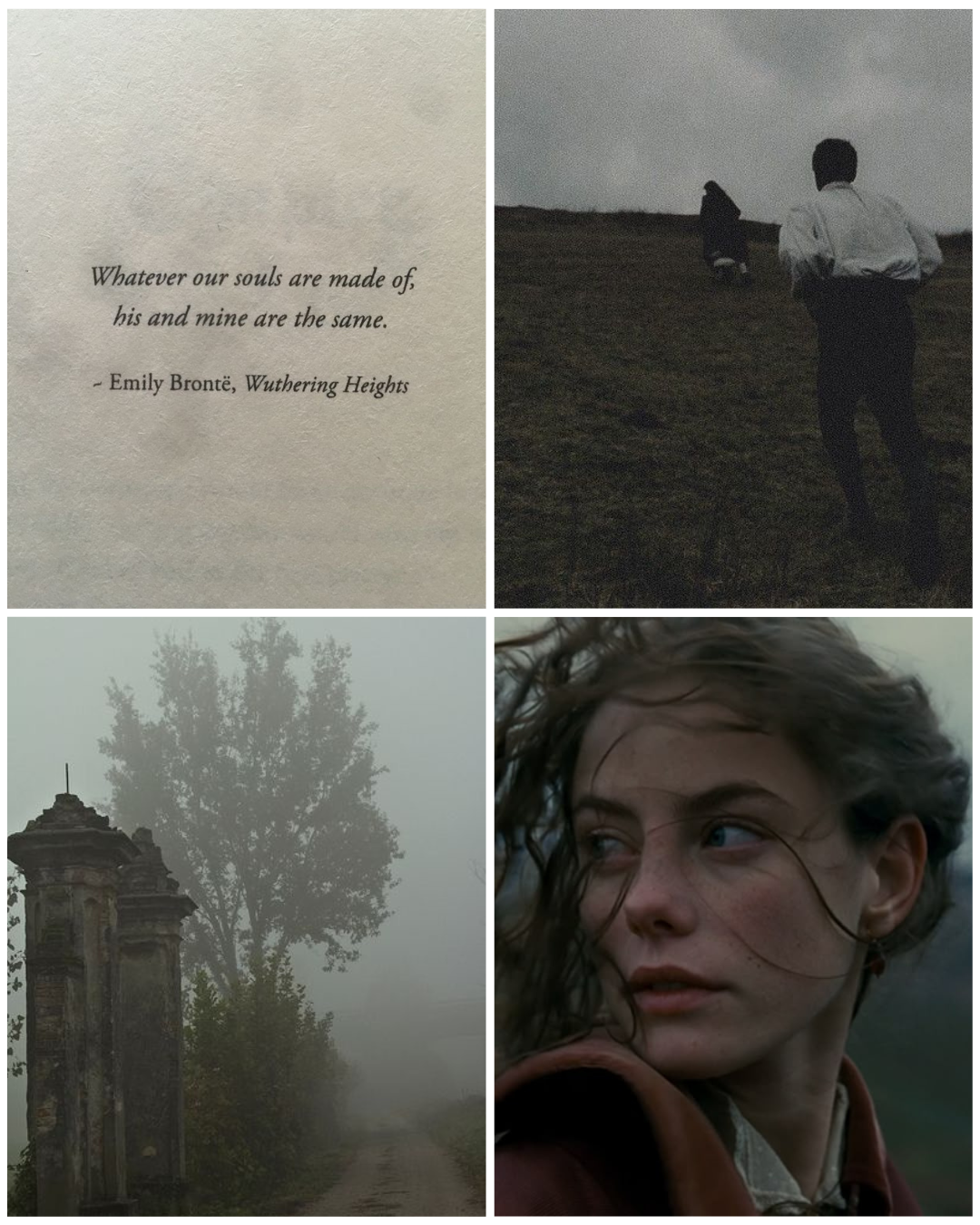
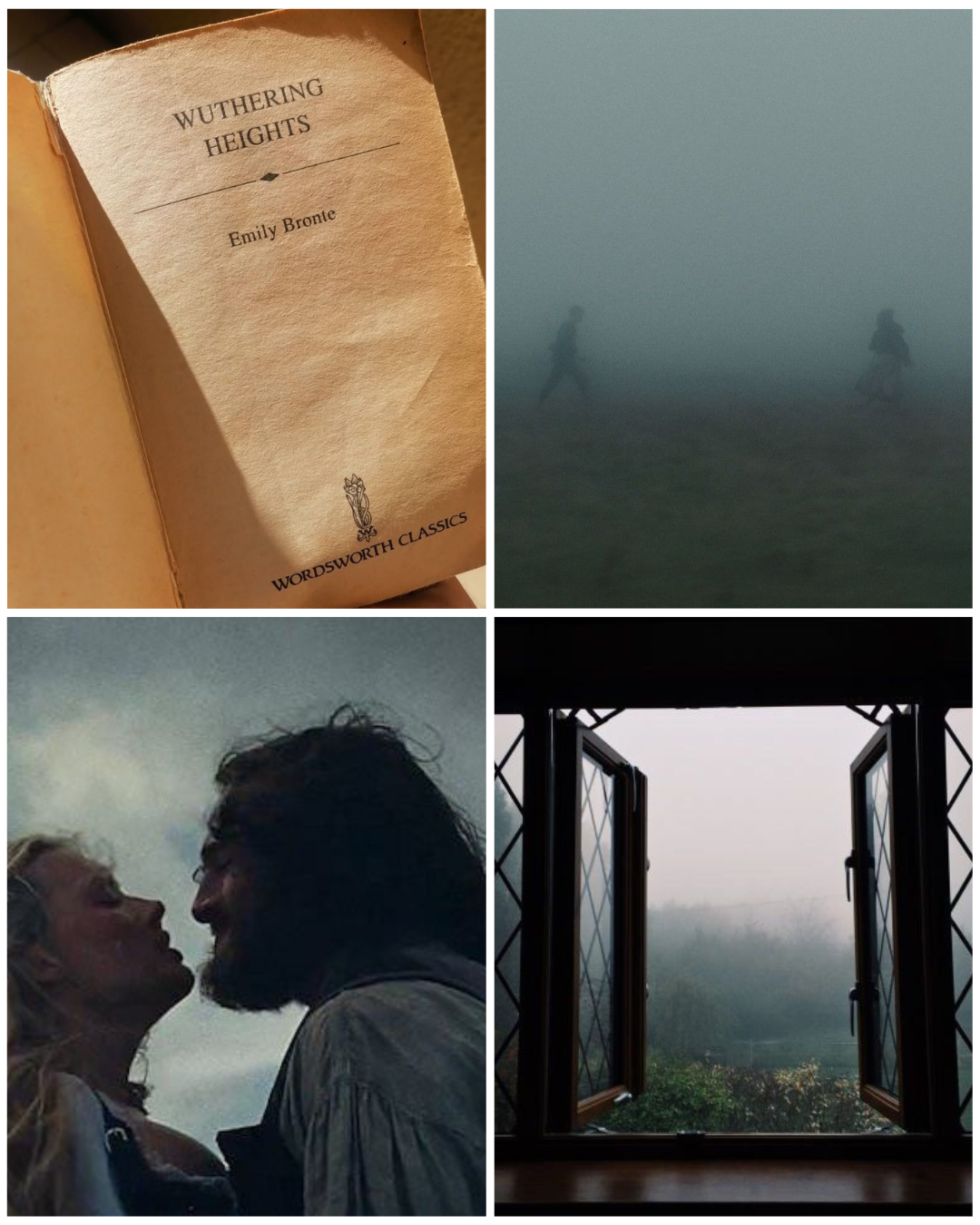
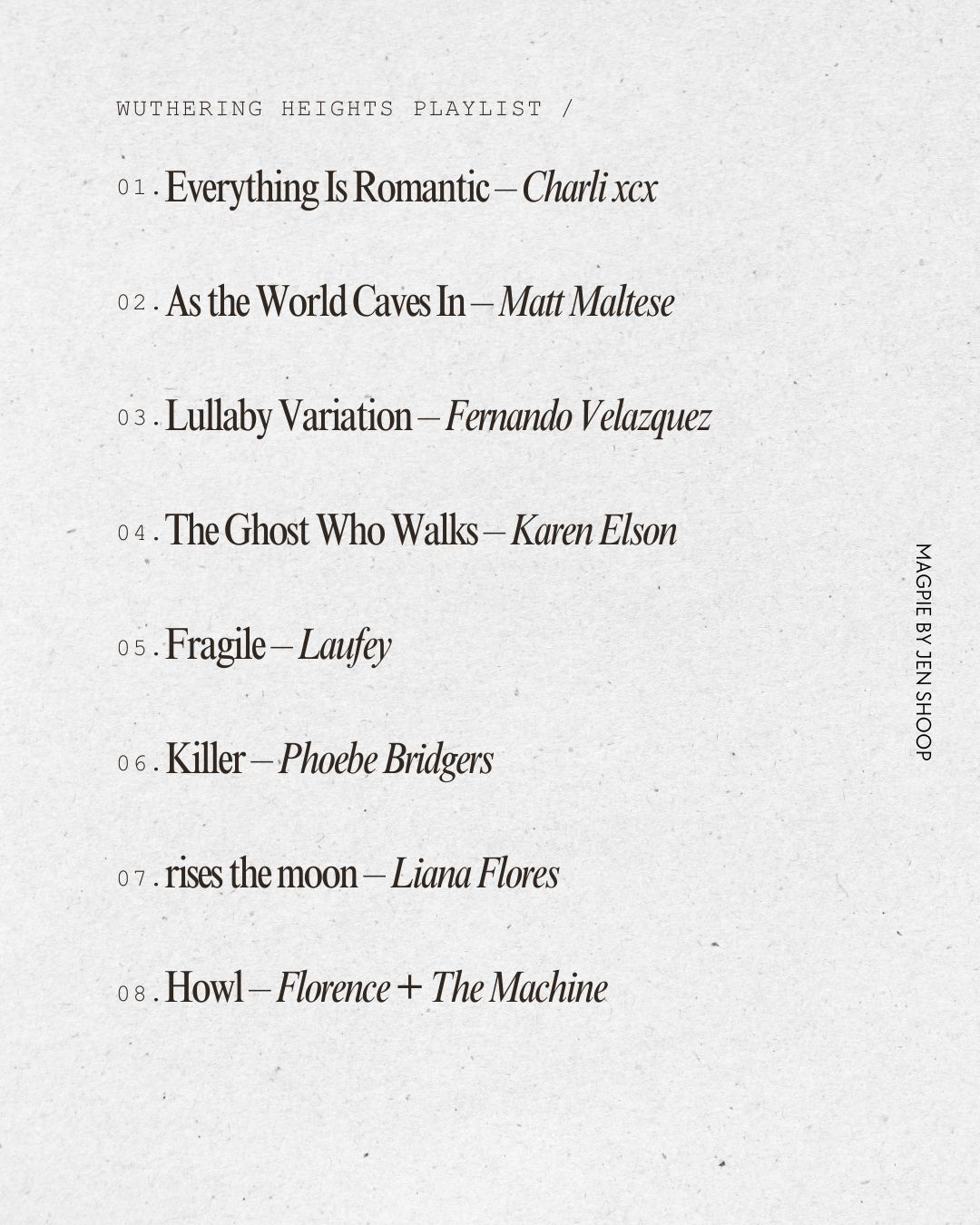
Wuthering Heights Playlist.
Of course had to include the Charli xcx song from the trailer to the Emerald Fennell film adaption of Wuthering Heights in this! (They just released a second trailer this week; watch here! And I just discovered that Charli xcx has an entire Wuthering Heights album coming out! You can preview a few tracks here.) I had a complete blast compiling this moody-broody-witchy-heathy playlist, with a mix of strong, howl-y female ballads and slightly alt, cinematic symphonics. A kiss of the occult. I consulted with this fantastic Reddit thread, titled “Music that makes me feel like I’m the heroine in a gothic novel like Jane Eyre or Wuthering Heights?” and included several recommended tracks. Landon and I are also fascinated / obsessed with Wet Leg and her song CPR is absolutely pitch-perfect for the Fennell film version of this book.
I included a Kate Bush song (I know she has a true cult following) because it felt just right but she also has a track (not on my playlist) titled “Wuthering Heights.” I find it a little difficult to listen to in a playlist context but could be worth a tune in if you’re intrigued or into her.
You can get the playlist on Spotify here and Apple here.
Wuthering Heights Movie Adaptations.
I am curious to watch as many of the film adaptations of this book as possible! The book is intriguingly ambiguous on so many points (including plot — I read and re-read the section in which Catherine dies multiple times to make sure she had in fact died), and I’m itching to witness the confidence of a director pinning certain things one direction or another. I’m also very intrigued by the Emerald Fennell adaptation. There are a few controversies surrounding it — first, the fact that Heathcliff was not cast as a person of color (in the novel, Bronte describes him as “a dark-skinned gypsy” [sic] with “black eyes”); second, the inaccurate costuming; and third, the eroticization of the novel. (Someone described the film’s adaptation as “the Colleen-Hooverification of Bronte” — !!) In spite of this context, and perhaps slightly because of it, I’m eager to tune in. I’m generally pretty lenient on creative adaptations (why can’t we spin things further out? why can’t we reimagine, chase things to further endings, reapply to new contexts? — there are so many popular adaptations of Shakespeare that would probably offend true scholars but I love them still), and I think it’s interesting that Fennell placed the title of the movie in quotations (it’s “Wuthering Heights” in the title, not Wuthering Heights), which to me signals some acknowledgment that there will be slippage and manipulation. (…Are we meant to understand it as satire? Or at least as an adaptation, air-quotes-style, with all the laxity and loophole that implies?) I’ve read somewhere that the film may actually contain a frame story of a woman imagining herself in the position of Catherine in the novel after reading it? Whether this is a cute/clever way to give Fennell a longer leash to play with the source material or more philosophical — TBD. But certainly the Bronte source text is messing with multi-layered narrative, mise en abime, story in story, and so there is a thematic synchrony there. (Perhaps Fennell adding multiple additional layers of narrative inconsistency is Bronte-core?!)
Wuthering Heights-Inspired.
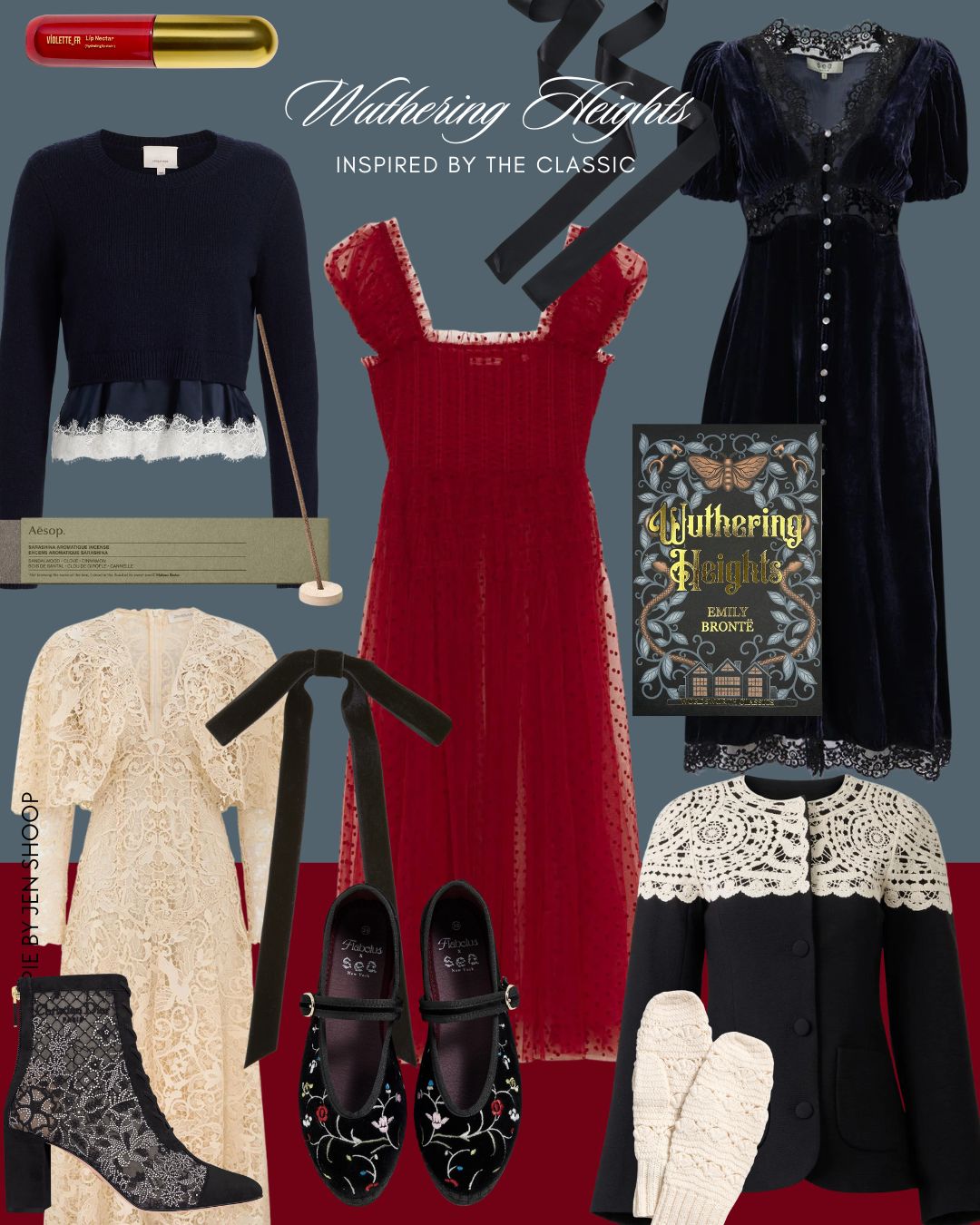
SEA’s latest collection — full of lace trim, capes and hoods, and a slight vampiness — is Wuthering Heights coded in the best way. I am completely obsessed with their lace-embellished jacket (seen below). You can also rent it at Rent the Runway! Fab statement for the season. Check out this puffer jacket! Those poet cuffs!

More great WH-coded find below —
VIOLETTE FR LIP // CINQ A SEPT LACE TRIM SWEATER // INCENSE // DOEN RED DRESS // ZIMMERMANN LACE DRESS // DIOR BOOTS // VELVET HAIR CLIP // SEA EMBROIDERED VELVET FLATS // SEA NAVY VELVET DRESS // SEA NARA JACKET // SEA MITTENS // WUTHERING HEIGHTS BOOK
Magpie December Book Club Pick.
For December, we will be reading Lily King’s Heart the Lover. So many of you are already reading this book, or just finished it — I was bowled over by the volume of you who replied to an Instagram prompt asking “what are we reading? what’s good?” with this book! I’ve never read King but know many of you are enormous fans.
If you want something more seasonal, I’m currently reading Claire Keegan’s Small Things Like These. Keegan is another Magpie favorite writer! Several of you re-read this particular book of hers every year in December.
What else are you reading? Anything we need to know about?
P.S. All about our bad book girl culture.
P.P.S. Updated Shopbop hearts! I’m also working on some updated Amazon guides: just curated a list of great white elephant / stocking stuffer gifts (all or almost all under $25) and some children’s gifts here.
P.P.P.S. The softest kinds of love and the best book-based movies.
My book, Small Wonders, is now available for pre-order! This is a collection of essays, musings, and list poetry on the art of paying attention, noticing love in its smallest denominations, and finding the miraculous in the mundane. It is an extension of the writing here on the blog, and is organized around the themes we often discuss here: the dance of motherhood, inheritances and intimacies, the natural world, and the wide world of language. I am so proud of it and hope you will find it a worthy companion for your legato-style mornings.
This post may contain affiliate links. If you make a purchase through the links below, I may receive compensation.

Please read Anne Bronte’s The Tennant of Wildfell Hall, if you haven’t yet! A book so progressive that Charlotte (the last surviving sister) refused to have it republished in her lifetime. It’s a nice middle ground between Jane Eyre (the most realistic/grounded imo) and Wuthering Heights (unhinged, feral, etc) lol
Oo love this. Added to my TBR. Also “feral” is a great way to describe WH!
xx
Wuthering Heights is the perfect choice for this moment in history. Unlike Jane Eyre —a novel that dines a bit of redemptive light in the darkness and finally brings sight to the ;anti) hero, WH offers no hint of lightness. The sweetness of the 2nd Catherine and her saccharin husband never stand a chance. Everyone has their own motive.
Wuthering Heights is,I think, more akin to Frankenstein than Jane E. But rather than critiquing science Brontë implicates capitalism, modernism and the rising industrial age that was corrupting the moors. It’s not for nothing that H is (seemingly) the illegitimate son on the 1st Catherine’s father, the mutt and disrupter of a corrupt and flawed inheritance. (In this regard H is rather like Mordred in the Camelot tales )
But H is also the unbound and destroying Id. He is the dark force of sexuality, self indulgence and will, and avarice come to topple sweet surfaced Victorian morality. His goal is not happiness—obviously—but to burn everything down.
And this is what the Romantics wanted—revolution. WH is not a comforting , beautiful tale. It’s riveting and scary.and kind of an apocalyptic morality tale for our own universe at this moment. Unregulated greed and desire and narcissism destroy everyone.
Completely agree – it’s like the anti-bildungsroman. Instead of moral progress / character dev, it’s moral decay and character atrophy. It must have taken a lot of guts to write this way — just unremitting, unrelenting!
Thanks for sharing this read. I liked your capture of Heathcliff as the “unbound and destroying id.”
Did you buy Heathcliff and Catherine’s relationship as love or something else?
xx
Such an interesting question. Heathcliff and Cathy don’t fit any healthy contemporary definition of love. They don’t make each other better, they’re not about building a life or any of things that make up long lasting serious affection. They are potential adolescents caught up in their own angst and drama. One can’t quite picture them going to couples’ counseling or H installing a baby seat in the back of the Subaru Outback. Thru are about the drama and self involvement. When Cathy says I am Heathcliff she means it. They are literally mutually self absorbed. But that’s why they and Romanticism are so compelling—there’s that desire to see yourself looking back from the mirror that’s another and there’s something beautiful about tragic teenage love. It may not really be love and it’s undoubtedly destructive but the idea of experiencing emotion so powerful that it wipes out everything else is both frightening and (again to our I’d selves) attractive. So—love—maybe— in a decidedly unhealthy way.
This is such a great read, and I loved your comment about Heathcliff not really being the type to install a carseat — lol.
Thanks for sharing this!
xx
OMG as soon as I saw this post, I made a cup of tea and settled in…
Just finished re-reading and agree with so many of the frustrations of others. I kept asking myself questions like:
“Is there no one else to socialize/court/fall in love with??”
“Why after all the warnings does Cathy still want to go to WH?”
“Linton is the whiniest, sickliest, most emasculated man ever, why would Cathy want to be with him?”
“Does anyone in this book want to try to be happy?”
When Catherine is dying and Heathcliff visits her, I feel like she just wants Heathcliff to feel like it’s his fault that she’s dying. She doesn’t really seem to love him, she just wants to torture him. Just like Heathcliff wanted to torture her by marrying Isabella. It’s such a sickening business!
I will say, when Catherine tells Ellen that her and Heathcliff’s souls are the same that it gave me chills, but I think it’s just because they are the same selfish, wreckless people, not because they love each other.
I watched the Tom Hardy (love him) as Heathcliff version years ago and hated it. It’s just not the kind of book or film I think I could ever really love? Hoping the new adaptation can deliver a little something extra (maybe it will since you mentioned they amped it up a notch).
I love the idea of you seeing this post and making a cup of tea – thank you for that little detail. You have no idea how rewarding that is to hear! I spent a lot of time on this post; thank you 🙂
I loved your description of Linton – completely agree. There are a few points in the novel where Bronte completely emasculates him alongside Heathcliff. It’s brutal. The most unhinged sequence takes place in Ch 11, right before Heathcliff and Linton exchange blows:
[Catherine, to her husband]: “Heathcliff would as soon lift a finger at you as a king would march his army against a colony of mice. Cheer up! you shan’t be hurt! Your type is not a lamb, it’s a suckling leveret.”
“I wish you joy of the milk-blooded coward, Cathy!” said her friend [Heathcliff]. “I compliment you on your taste. And that is the slavering, shivering thing you preferred to me! I would not strike him with my fist, but I’d kick him with my foot, and experience considerable satisfaction. Is he weeping, or is he going to faint for fear?”
UNREAL. Like the level of their nastiness!!!
xx
The blurb on my audio copy of WH says “Considered to be one of the greatest novels ever written in English…” and my response is – how???? By who?? I was hoping that revisiting this as an adult would redeem it in some way, but I retain my initial dismissal. Maybe this goes back to my reason for reading (entertainment, escape, enjoyment) and this book was just depressing and frustrating. Not to mention confusing – I used the online cliff notes starting when Lockwood spends the night at WH and is reading journals and I was not sure who was talking, what time period, etc. Maybe this was worse due to audio format. I also found it hard to picture WH and the grange – less brooding, more word pictures, please! I am perplexed by everyone needing weeks to convalesce from a cold, a dog bite, etc (not unique to this book but just added to my dislike of the characters). Also, how did no one see through Heathcliff’s manipulations? Too self-centered and/or drunk, perhaps. I feel like I’m revealing my practical mindset with this review, ha! Loved that bcvitalwrites meme!
Stephanie, I feel seen. I struggled so much with this book, I wanted to love it. I Tried reading it AND the audiobook.. maybe I was just not in the correct mindset to focus. I felt confused even by the chapter summaries online! Fail on my part I guess. And, wouldn’t it be nice to convalesce for weeks from a cold?
No failing on your part! You’re totally entitled to these views, which I agree with — it IS confusing to follow and there is no redemption for any character! I grew to admire these aspects from a craft standpoint and came to enjoy the richness and complexity of the text, but I wouldn’t say I “loved” any of the characters and it didn’t elicit any great feelings in me (or, really, any big lightbulb moments or emotional connection points). But I think this is yet another part of the multivalence of reading, and being a reader. I think there are lots of reasons and ways to read. Sometimes I’m just not in the mood for reading as a purely intellectual exercise — sometimes I want to FEEL something, some emotional connection, etc!!
Nothing new here, just swooping in to validate you in this view! I actually think a lot of people agree!
xx
Thank you… I want to try this book again when my life is not so scattered. I did love your review.
Absolutely! I am so firmly in the camp of waiting for the right moment to read something. I remember an analogy along the lines of “imagine books like fine wines, just waiting for the right moment to be opened.” xx
You’re not alone in these views; I read a review in “The Guardian” maybe where the literary critic describes it as “a hot mess.” LOL. I agree with you that it’s not a kind reading experience for the reader. The layers of narrative (diaries, memories within memories) demand a lot of us. I think this was intentional on her part — but making an intellectual point at the disservice of the reader is…bold! Rude? Unkind? Heathcliff-like? Ha.
I laughed at your comment about people needing weeks to convalesce for a dog bite. I think Catherine recovers for five weeks at a neighbor’s house after twisting her ankle?! LOL. I think these are mainly plot contrivances but surely there are more credible ways to create space for character separation…
Bummed you didn’t enjoy this as much as I did BUT I appreciate your reading along and feel like your commentary is an important part of the analysis here!
xx
I can’t wait to hear your thoughts on Heart the Lover! I adored it and Writers and Lovers. HTL is definitely in my top 3 favorite books of the year.
I have a feeling I’m going to agree with your ranking! I’m totally absorbed in it. I think the other great book from the year was “Wild Dark Shore.” Loved it!
I LOVED Heart the Lover! So looking forward to hearing what you have to say about it. A friend who is a huge fan told me that it is a prequel/sequel to Writers and Lovers which I tried to read so many times and failed…but the hype was real and he told me give this a chance and I’m so glad I did! Honestly I think I’m going to go give Writers and Lovers another chance now.
Oh interesting! This is my first foray into her work, but I know a lot of people love W&L. Can’t wait to chat. I stayed up very late last night reading HTL! Couldn’t put it down! Looking forward to the chat –
xx
Heart the Lover is wonderful! I have read all her books; For me, HTL and Euphoria are her best novels. Sharp-eyed UNC alums (King is one; me too) will note thinly-disguised Chapel Hill references in HTL. I look forward to the upcoming discussion.
Ooo this is so intriguing! I recall you recommending her in a previous post. I am LOVING HTL. I stayed up until way too late reading it last night — couldn’t put down! I have a feeling I will need to tear through her back list after!
xx
DMV Magpies: Lily King is reading 11/18 at 7 PM at Politics & Prose Union Market location.
OMG how did I miss this? Seeing if I can swing it. TYSM
Not gonna lie, I hated this book in high school and have never felt compelled to try it again, BUT I can heartily recommend the 2022 movie Emily, a lightly fictionalized account of Emily Bronte’s life starring Emma Mackey. It’s a gorgeous, super evocative film, and a lot of the cinematography reminded me of Call Me By Your Name (many static shots of leaves in the breeze through windows)
Immediately added to my “to watch” note on my iPhone! Right up my alley — TYSM!
xx
I’d love to point you to Dr Sam Hirst’s excellent Romancing the Gothic YouTube! I’ve gone to some of the virtual talks and events as well https://youtube.com/@romancingthegothic?si=T6DtSI1egbfcTUrX
My favorite modern gothic author is KJ Charles since she has such a deep, encyclopedic knowledge of the genre and a gift for irredeemable characters.
I personally like the aesthetics of a gothic novel but I’m a wuss about horror/psychological elements, I think Portrait of a Lady On Fire is about as far as I like to go. Love a looming cliff but I’ll take a miss on the grave digging
Oo thank you! I am going to listen to that talk while folding laundry today!
I also loved Portrait of a Lady on Fire! Have been meaning to re-watch.
xx